
Osteopathic Manipulative Treatment in Novi, MI
The human body is a connected system. Pain in your knee may originate in your hip. A rib out of place can cause chest pain that mimics a cardiac event. Plantar fasciitis can be driven by rotation in your pelvis. At PrimeCare of Novi, Dr. Zaid and Dr. Shively use osteopathic manipulative treatment to find and correct the structural causes of pain — not just manage the symptoms.
| ✓ Back pain, neck pain, and rib dysfunction |
| ✓ Hip, knee, and foot pain from structural causes |
| ✓ Chest pain evaluation — cardiac vs. musculoskeletal |
| ✓ Performed by Dr. Zaid and Dr. Shively — both DOs |
| Request an appointment | 📞 (248) 426-7200 |
Serving Novi, West Bloomfield, Northville, Farmington Hills and all of Oakland County
|
WHAT IS OSTEOPATHIC MEDICINE Medicine that treats the whole body as a connected systemOsteopathic medicine is a complete system of medical care grounded in the principle that structure and function are inseparable. When the body’s structure is compromised — a restricted joint, a misaligned rib, a rotated pelvis — function suffers throughout the connected system, often far from the original problem. Doctors of Osteopathic Medicine (DOs) complete the same medical school curriculum as MDs — plus additional training in osteopathic manipulative medicine (OMM). This means a DO can prescribe medication, order imaging, perform surgery, and practice in every medical specialty — while also having the training to use their hands to diagnose and treat structural dysfunction directly. At PrimeCare of Novi, Dr. Robert Zaid and Dr. Theodore Shively are both Doctors of Osteopathic Medicine who actively incorporate OMT into their practice — a combination that gives their patients access to both comprehensive medical care and hands-on structural treatment in a single visit. |
The osteopathic principle 1
The body is a unit — mind, body, and spirit are interconnected
2
Structure and function are interrelated — dysfunction in one affects the other
3
The body has self-healing capacity — OMT removes barriers to that capacity
4
Rational treatment — based on understanding these three principles together
DOs vs MDs Both are fully licensed physicians. DOs complete the same medical training plus an additional 200+ hours of osteopathic manipulative medicine — giving them an additional diagnostic and treatment tool most MDs do not have. |
CONDITIONS WE TREAT
Pain is rarely where the problem actually is
One of the most important things osteopathic medicine teaches us is that the location of pain and the source of pain are often different. Treating where it hurts is not always treating why it hurts.
|
🦴 Back pain from a rib out of place A posteriorly displaced rib head can produce sharp, stabbing back pain that worsens with breathing and is often mistaken for a pulled muscle or spasm. Standard treatment addresses the muscle — osteopathic treatment addresses the rib. Restoration of normal rib mechanics typically resolves the pain within one to two sessions. |
🦵 Hip and sciatic pain from innominate rotation The innominate bones — the two halves of the pelvis — can rotate anteriorly or posteriorly, shifting the position of the sciatic nerve and creating pain that radiates down the leg. This is often diagnosed as sciatica when the true cause is pelvic asymmetry. Correcting innominate rotation restores normal nerve tension and resolves the radiating pain without injections or surgery. |
🦶 Plantar fasciitis from hip and leg rotation Chronic plantar fasciitis that does not respond to stretching and orthotics is often being driven by tibial or femoral rotation — the foot is forced into a position that overloads the fascia on every step. Treating only the foot misses the mechanical origin entirely. Correcting rotational dysfunction in the hip and leg changes the load mechanics in the foot — often resolving months of heel pain. |
|
🤕 Neck pain and headaches Cervical somatic dysfunction — restricted motion in the neck vertebrae — is a common cause of tension headaches, occipital neuralgia, and upper back pain. OMT restores normal cervical mobility and relieves the muscular tension that drives these symptoms. |
💪 Shoulder pain and rotator cuff dysfunction Restricted thoracic mobility and rib dysfunction frequently contribute to shoulder impingement and rotator cuff problems. Restoring normal thoracic and rib motion changes the biomechanics of the shoulder — often dramatically reducing pain without injections. |
🏃 Athletic and sports injuries From overuse injuries to acute sprains, OMT accelerates recovery by restoring normal tissue mechanics, reducing inflammation through improved lymphatic drainage, and correcting the compensatory patterns that develop after injury and lead to reinjury. |
CHEST PAIN AND THE OSTEOPATHIC EXAMINATION
Is it your heart — or is it your spine?
Chest pain is one of the most anxiety-producing symptoms in medicine — and for good reason. But a significant proportion of chest pain presentations in primary care have a musculoskeletal origin, not a cardiac one. The challenge is knowing the difference. A DO-trained physician brings a unique advantage to this evaluation.
|
❤️ The viscerosomatic reflex Osteopathic medicine recognizes that internal organs and the musculoskeletal system share spinal nerve pathways. When the heart is under stress, it can produce reflex changes in the muscles and tissues along the corresponding spinal segments — typically T1 through T5 on the left side. This means a trained osteopathic physician performing a structural examination can identify tissue texture changes, restricted motion, and asymmetry in the thoracic spine that may indicate cardiac involvement — findings that a standard physical exam would not detect. Source: StatPearls, NCBI — “Patients who present with chest pain may have an underlying cardiac issue with a corresponding somatic dysfunction at T1-T5 of the spine.” |
🦴 When the chest pain is structural Rib dysfunction — particularly a posteriorly displaced rib head at the costovertebral joint — can produce anterior chest pain, left arm discomfort, and even shortness of breath that closely mimics cardiac symptoms. Costochondritis, thoracic somatic dysfunction, and intercostal nerve irritation are common culprits. After cardiac causes have been appropriately ruled out, OMT can provide rapid, lasting relief. In one published case, a patient with three weeks of continuous chest pain — who had undergone extensive cardiac testing with no findings — had complete resolution after a single osteopathic treatment session using myofascial release. Source: The American Journal of Medicine — “OMM can effectively treat somatic dysfunction such as musculoskeletal chest pain.” |
The advantage of a DO: the ability to identify cardiac risk AND correct structural dysfunction — in the same visit
Dr. Zaid and Dr. Shively can order an EKG, cardiac enzymes, and imaging to rule out serious cardiac causes — and then, when the pain is structural, treat it directly rather than sending you home with “it’s not your heart” and no answers.
THE EVIDENCE
What the research says about OMT and pain reduction
The evidence base for osteopathic manipulative treatment has grown substantially over the past decade. Here are three recent studies that reflect the current state of the research.
|
Chronic Low Back Pain · 2024 OMT produced clinically significant pain reduction with an effect size of 0.8 SD A randomized controlled trial of 80 patients with chronic low back pain found that 3-4 sessions of OMT over 4-6 weeks produced a statistically and clinically significant reduction in average pain scores. Improvements in sleep disturbance and anxiety were also reported — with no serious adverse events. Popovich et al. (2024) — Journal of Osteopathic Medicine · Michigan State University College of Osteopathic Medicine |
Knee Pain · 2024 OMT reduced knee pain scores by nearly 4 points on a 10-point scale vs. no treatment A meta-analysis of randomized controlled trials found a mean pain reduction of -3.95 on the visual analog scale in patients with patellofemoral pain syndrome treated with OMT compared to no treatment — a statistically significant finding (p < 0.01) with results maintained at 30-day follow-up. Delgadillo et al. (2024) — Cureus / PubMed · Lake Erie College of Osteopathic Medicine |
Shoulder Pain · 2024 OMT produced a mean pain reduction of -4.28 points for localized shoulder pain A meta-analysis of randomized controlled trials examining OMT for joint pain found significant results specifically for shoulder pain, with a mean difference of -4.28 (-4.86 to -3.70) on the visual analog scale and a p-value below 0.0001 — one of the strongest findings in the joint pain literature. Meta-analysis (2024) — PMC / PubMed · Efficacy of OMT for Pain Reduction in Localized Joint Pain |
These studies represent peer-reviewed published research. OMT outcomes vary by individual, condition severity, and technique. Your physician will discuss realistic expectations at your consultation.
YOUR OSTEOPATHIC PHYSICIANS IN NOVI
Two DOs. One practice. Both performing OMT.
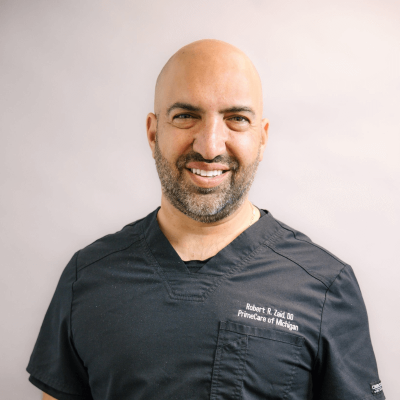
Dr. Robert Zaid, DO Family Medicine · Osteopathic Medicine · Concierge Dr. Zaid is a Doctor of Osteopathic Medicine with over two decades of experience in family medicine and osteopathic manipulative treatment. He incorporates OMT into his practice as a primary tool for diagnosing and treating musculoskeletal dysfunction — and as a lens through which he evaluates every patient’s structural health alongside their medical history. |
TS Dr. Theodore Shively, DO Family Medicine · Osteopathic Medicine · Aviation Medical Dr. Shively is a Doctor of Osteopathic Medicine with extensive experience in family medicine and osteopathic manipulative treatment. His approach to patient care reflects the core osteopathic principle that addressing structural dysfunction is essential to restoring function — not an afterthought to conventional treatment. |
|
PERSONALIZED CARE OMT works best when your physician knows your body over timeOsteopathic treatment is not a one-size-fits-all procedure. The most effective OMT comes from a physician who has examined you repeatedly, knows how your body moves, understands your structural patterns, and can detect subtle changes from one visit to the next. In our Personalized Care program, your physician has the time and the continuity to do exactly that. Extended appointments, regular structural assessments, and a physician who knows your history are the conditions under which osteopathic medicine delivers its best results. ✓ Regular structural assessments as part of your wellness plan
✓ OMT available at every visit — not just when things break down
✓ A physician who notices structural changes before they become pain
✓ Extended visits — time to address the whole picture, not just today’s complaint
|
🖐️ Prevention through structure Most pain is predictable — if someone is watching. Structural dysfunction rarely appears overnight. A progressively restricted thoracic spine, a slowly rotating pelvis, a developing sacroiliac imbalance — these changes accumulate over months and years before they become acute pain. A physician who sees you regularly and performs structural assessments can identify these patterns early — and correct them before they produce the injury, the compensation pattern, or the chronic pain that follows. |
COMMON QUESTIONS
Frequently asked questions about osteopathic medicine at PrimeCare of Novi
Where can I find an osteopathic physician in Novi, MI?
PrimeCare of Novi has two Doctors of Osteopathic Medicine on staff — Dr. Robert Zaid and Dr. Theodore Shively — both of whom actively perform osteopathic manipulative treatment. We are located at 39555 W. Ten Mile Road, Suite 302, Novi, MI 48375. Call (248) 426-7200 or request an appointment online.
What conditions can osteopathic manipulative treatment help with?
OMT is most commonly used for musculoskeletal conditions including low back pain, neck pain, rib dysfunction, sciatica, hip pain, shoulder pain, headaches, and plantar fasciitis. It can also be used to evaluate and treat chest pain of musculoskeletal origin, and as a component of care for conditions affecting the nervous system, circulatory system, and lymphatic system.
Does OMT hurt?
Most OMT techniques are gentle and should not be painful. There are many different OMT techniques — from soft tissue work and myofascial release to muscle energy and gentle articulation. Your physician will choose the techniques appropriate for your condition, your age, and your comfort level. Some patients experience mild soreness for 24-48 hours after a session, similar to the feeling after a massage or workout.
How is a DO different from a chiropractor?
A Doctor of Osteopathic Medicine (DO) is a fully licensed medical physician who can prescribe medication, order imaging, perform surgery, and practice in any medical specialty — in addition to being trained in osteopathic manipulative medicine. A chiropractor is not a medical doctor and focuses primarily on spinal adjustment. A DO brings the full scope of medical training plus hands-on structural treatment — the combination allows them to both rule out serious medical causes and treat structural problems directly.
Can OMT help with my chest pain?
First, any chest pain should be evaluated to rule out cardiac causes — and our physicians will do exactly that with an EKG and appropriate testing. Once serious cardiac causes have been excluded, OMT can be highly effective for chest pain of musculoskeletal origin — including rib dysfunction, costochondritis, thoracic somatic dysfunction, and intercostal nerve irritation. These conditions frequently mimic cardiac symptoms and are often missed in a standard evaluation.
How many OMT sessions will I need?
This depends entirely on your condition, its duration, and how your body responds. Acute conditions — like a rib out of place from a cough or sneeze — often resolve in one to two sessions. Chronic conditions with long-standing compensatory patterns typically require more sessions over several weeks. Your physician will give you a realistic expectation at your first visit.
Is OMT covered by insurance?
OMT performed by a physician (DO) is covered by most major insurance plans including Medicare, Blue Cross Blue Shield, Aetna, and United Healthcare when medically indicated. Coverage varies by plan. Call our office at (248) 426-7200 and our staff will verify your coverage before your appointment.
SCHEDULE YOUR OMT EVALUATION
Find out if your pain has a structural cause
A structural evaluation with Dr. Zaid or Dr. Shively takes the same amount of time as a standard appointment — and may explain pain you have been managing for months or years without resolution.
| Request an appointment | Personalized Care | 📞 (248) 426-7200 |
|
📍 39555 W. Ten Mile Rd, Suite 302
Novi, MI 48375
|
Mon–Fri 8AM–5PM
Same-week appointments often available
|
Dr. Zaid & Dr. Shively
Both DOs · Both performing OMT
|