
Revisiting Hormone Therapy: From Fear to Confidence
A Novi family physician reflects on how two decades of evolving research — including the 2023 TRAVERSE study — changed how he thinks about menopause and hormone therapy.
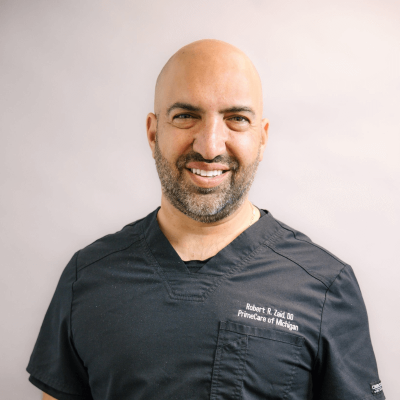
Dr. Robert Zaid, DO Board-Certified Family Medicine |
3 min read Est. reading time |
Updated 2025 TRAVERSE study referenced |
“At this point in my career I am now a physician working in Novi who is comfortable prescribing hormone therapy for women in perimenopause and menopause. I am constantly learning and studying as this field is ever changing.”
— Dr. Robert Zaid, DO · PrimeCare of Novi
When I graduated from medical school in 2005, the medical community was still reeling from the results of the Women’s Health Initiative (WHI) and the Nurses’ Health Study. These landmark studies had cast long shadows over hormone replacement therapy, particularly estrogen and testosterone. As young physicians, we were taught to avoid hormone correction out of fear that we might inadvertently increase the risk of heart disease, stroke, or cancer. Despite watching patients struggle with the effects of low testosterone and menopause, many of us hesitated to act.
For men, symptoms of low testosterone — fatigue, brain fog, loss of muscle mass, and low libido — were often dismissed as normal aging. For women, menopause was something to “get through,” not something to treat aggressively. It was frustrating. We knew our patients were suffering, and instinctively, we believed hormone optimization could help. But the fear ingrained in our training overrode our clinical intuition.
Over the years, that fear has gradually given way to a more nuanced understanding. Thanks to newer, more targeted studies, I’ve grown increasingly confident discussing hormone therapy with patients, particularly as I’ve engaged with emerging data and committed to staying current.
2023 TRAVERSE STUDY — A GAME CHANGER
“Testosterone-replacement therapy was noninferior to placebo with respect to the incidence of major adverse cardiac events.”
The TRAVERSE study followed more than 5,000 men aged 45–80 with low testosterone and preexisting cardiovascular risk factors. The findings were striking: testosterone therapy did not increase the risk of major cardiovascular events. For many physicians who had been cautiously optimistic, this was a game-changer.
For women, estrogen therapy has also undergone a reassessment. We now understand that timing, formulation, and delivery method matter. When prescribed appropriately — especially early in the menopausal transition — hormone therapy can improve quality of life without the previously assumed risks. It’s not about ignoring safety concerns; it’s about putting those concerns into context with up-to-date science and individualized care.
As a practicing physician, I’m now far more comfortable initiating these conversations. I look at the whole patient — their symptoms, goals, family history, and risk profile — and I engage in open, honest discussions about the potential risks and benefits of hormone therapy. Patients are grateful to be heard, and I’m grateful to be in a place where I can offer real solutions based on better evidence.
Looking back, I understand why we were cautious. But we’re in a different era now — one that embraces complexity and encourages shared decision-making. What once felt risky now feels responsible when done thoughtfully and informed by current research. Medicine evolves, and so do we. I’m proud to say that my approach has matured along with the science, and my patients are better off because of it.
Dr. Zaid’s approach today
Whole-patient evaluation. Up-to-date evidence. Honest conversations about risk and benefit. A physician who has the time to get it right.
|
|
ABOUT THE AUTHOR Dr. Robert Zaid, DO Dr. Zaid is a board-certified family physician who has practiced in Novi since 2004. He has evolved his practice toward a personalized, concierge medicine model — giving him the time to stay current on evolving research and to have the honest, unhurried conversations that good care requires. |
|
🌸 MENOPAUSE CARE AT PRIMECARE Looking for a physician who will actually treat your menopause?Dr. Zaid and our team offer individualized menopause and perimenopause care — including hormone therapy when appropriate, based on your symptoms, history, and goals. ✓Hot flashes, night sweats, sleep disruption
✓Mood changes, brain fog, low energy
✓Low libido and vaginal symptoms
✓HRT — individualized by timing and formulation
|
👨⚕️ MEET DR. ZAID A physician who has the time to get your care rightDr. Zaid practices in a personalized concierge model — longer appointments, direct physician access, and a physician who stays current because he has time to read and think. ✓Board-certified family medicine
✓Practicing in Novi since 2004
✓2024 Hour Magazine Top Doc
✓Adults, children, and women’s health
|
READY TO TALK?
You deserve a physician who is open to this conversation
If you are navigating menopause, perimenopause, or questions about hormone therapy — Dr. Zaid is here and willing to have an honest, unhurried conversation about your options.
| Request an appointment | Menopause care → | 📞 (248) 426-7200 |
|
📍 39555 W. Ten Mile Rd, Suite 302
Novi, MI 48375
|
Mon–Fri 8AM–5PM
Same-week appointments often available
|
Personalized Care available
Extended visits · Direct physician access
|