
InBody 380 Body Composition Testing in Novi, MI
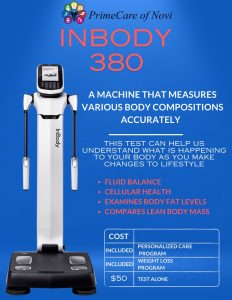
The scale tells you one number. The InBody 380 tells you what that number is made of — how much is muscle, how much is fat, and how much is water. At PrimeCare of Novi, we use InBody testing to track body composition trends over time, guide lifestyle changes, and show our patients that the work they are doing is actually working.
| ✓ Muscle mass, fat mass, and body water — all measured in minutes |
| ✓ Included in our weight loss and Personalized Care programs |
| ✓ Track changes over time — not just a single snapshot |
| ✓ Available as a standalone visit or added to any office appointment |
| Schedule your InBody test | 📞 (248) 426-7200 |
WHY THE SCALE IS NOT ENOUGH
Your weight is one number. Your body composition is the whole story.
Two people can weigh exactly the same and have dramatically different health profiles depending on how much of that weight is muscle versus fat versus water. The scale cannot distinguish between them. The InBody 380 can.
|
⚖️ WHAT THE SCALE TELLS YOU One number — total weightYour scale weight includes everything — muscle, fat, bone, water, and the contents of your digestive system. It changes throughout the day, goes up when you’re inflamed, goes down when you’re dehydrated, and tells you nothing about your actual body composition. Someone actively gaining muscle and losing fat may see no change on the scale for weeks — or even see the number go up — while their body is actually improving in every meaningful way. |
📊 WHAT THE INBODY 380 TELLS YOU A complete body composition breakdown✓
Skeletal muscle mass — how much functional muscle you carry
✓
Body fat mass and percentage — total and by region
✓
Total body water — intracellular and extracellular
✓
Lean body mass — everything that is not fat
✓
Basal metabolic rate (BMR) — how many calories your body needs at rest
✓
Visceral fat level — the dangerous fat around your organs
|
MUSCLE LOSS AND AGING
You are losing muscle right now — and most people have no idea
Sarcopenia — the age-related loss of skeletal muscle mass — begins as early as your 30s and accelerates significantly after age 50. Most people only notice it when they can no longer do things they used to do easily. By then, significant muscle has already been lost.
|
1–2%
muscle mass lost per year Starting around age 50, adults lose approximately 1–2% of skeletal muscle mass each year — accelerating to 3% or more annually after age 60. Source: ScienceDirect — Age-related loss of skeletal muscle mass and function |
~50%
of muscle mass can be lost by your 80s In severe cases, cumulative muscle loss from midlife onward can approach 50% by the eighth or ninth decade — dramatically affecting independence, fall risk, and metabolic health. Source: NIH News in Health — Slowing Sarcopenia |
📊
You cannot see sarcopenia coming without measuring it Early muscle loss produces no obvious symptoms. Body weight may stay the same or even increase as muscle is replaced by fat. The InBody 380 catches what the scale and the mirror miss — a declining muscle mass trend before it becomes a clinical problem. |
Why protein matters — especially when you are trying to lose weight
One of the most common and damaging mistakes in weight loss is not eating enough protein. When you restrict calories without adequate protein, your body turns to muscle for energy — accelerating the very muscle loss you should be fighting. At PrimeCare of Novi, we counsel patients on protein intake as a cornerstone of any weight loss plan, and we use the InBody to confirm what we hope to see: fat going down and muscle holding steady — or even increasing. We have seen many patients gain muscle while losing weight, and we can show them the evidence right on the machine.
HOW ACCURATE IS THE INBODY?
How InBody compares to DEXA — the gold standard
DEXA (dual-energy X-ray absorptiometry) is widely considered the gold standard for body composition measurement. Here is what the published research says about how InBody devices compare — and what that means for clinical use.
|
✅ Where InBody performs strongly →
High correlation with DEXA — InBody devices consistently show Pearson correlation coefficients of r ≥ 0.97 for both muscle mass and body fat mass compared to DEXA across multiple studies
→
Excellent reliability — intraclass correlation coefficients of ≥ 0.98 for body fat percentage and ≥ 0.99 for fat-free mass, meaning repeat measurements are highly consistent
→
Excellent for tracking change — when comparing pre vs. post assessments, InBody showed no statistically significant difference from DEXA in detecting changes in fat mass, fat-free mass, or body fat percentage over time
→
No radiation — unlike DEXA, InBody involves no ionizing radiation and takes under 2 minutes
Sources: Kim et al. (2025) Korean Journal of Health Promotion; Tinsley et al. (2019) Journal of Strength & Conditioning Research |
⚠️ What to understand about the numbers →
InBody devices tend to slightly underestimate body fat percentage and overestimate lean mass compared to DEXA — typically by around 2–4 percentage points
→
This means absolute values should be interpreted with context — the number on the InBody and the number on a DEXA scan may differ
→
Hydration status affects results — we ask patients to test under consistent conditions for the most accurate trending data
Our approach at PrimeCare of Novi We use the InBody primarily for trending — tracking how your composition changes over time under consistent testing conditions. This is where InBody excels and where it provides the most clinically useful information for guiding your care. |
HOW WE USE INBODY AT PRIMECARE OF NOVI
Measuring what matters — as part of a bigger picture
|
⚖️
Weight loss program InBody testing is included in our weight loss program to track real progress — not just scale weight. We use it to confirm that fat is being lost, that muscle is being preserved, and to guide protein recommendations. Seeing muscle go up while weight goes down is one of the most motivating results we can show a patient. |
🌟
Personalized Care members InBody testing is included as part of our Personalized Care program — tracked regularly so your physician can observe trends in muscle mass, fat distribution, and body water over time. This gives us a richer picture of your health than lab work and blood pressure alone. |
📅
Standalone or add-on visit You do not need to be in a program to get tested. InBody testing can be added to any office visit or scheduled as its own appointment. It takes under 2 minutes to complete and results are available immediately. |
I
COMMON QUESTIONS
Frequently asked questions about InBody testing in Novi
Where can I get InBody testing in Novi, MI?
PrimeCare of Novi offers InBody 380 body composition testing at 39555 W. Ten Mile Road, Suite 302, Novi, MI 48375. Testing can be added to any office visit or scheduled as a standalone appointment. Call (248) 426-7200 or request an appointment online.
How does InBody testing work?
InBody uses a technology called Direct Segmental Multi-Frequency Bioelectrical Impedance Analysis (DSM-BIA). You stand on the device and hold two handles — it sends a safe, imperceptible electrical current through your body and measures resistance to calculate your body composition. The test takes under 2 minutes and results are printed immediately.
How should I prepare for an InBody test?
For the most consistent results test at the same time of day each visit, ideally in the morning before eating or drinking. Avoid intense exercise for 12 hours before testing. Do not test immediately after a meal or after consuming large amounts of fluid. Consistent testing conditions are the most important factor for accurate trending over time.
Is InBody as accurate as a DEXA scan?
DEXA is the gold standard for body composition measurement. InBody devices show high correlation with DEXA (r ≥ 0.97) and are excellent for detecting changes over time — which is primarily how we use it clinically. InBody tends to slightly underestimate body fat percentage compared to DEXA, typically by 2–4 percentage points. For our purposes — tracking trends and guiding lifestyle interventions — InBody provides clinically meaningful and highly reliable data without radiation and at a fraction of the cost.
Can I gain muscle while losing weight?
Yes — and we see it regularly at PrimeCare of Novi. With adequate protein intake, resistance exercise, and appropriate caloric management, many patients simultaneously lose fat and gain or maintain skeletal muscle mass. This is sometimes called body recomposition. The InBody is one of the few tools that can actually show you this happening — and seeing that data is one of the most motivating things we can offer a patient working hard on their health.
Why does muscle mass matter as I get older?
Skeletal muscle is one of the most important indicators of long-term health and independence. Adults lose approximately 1–2% of muscle mass per year after age 50, accelerating after 60. This loss — called sarcopenia — is associated with increased fall risk, metabolic disease, difficulty with daily activities, and higher mortality. Detecting and addressing muscle loss early is one of the best investments you can make in your long-term health.
Is InBody testing covered by insurance?
InBody testing is typically not covered by standard health insurance plans as a standalone service. It is included as part of our weight loss program and Personalized Care membership. Standalone testing is available for a nominal fee — call our office at (248) 426-7200 for current pricing.
GET STARTED
Find out what your body is actually made of
Schedule your InBody test as part of a visit or on its own. Results in under 2 minutes. No radiation. No fasting required.
| Request an appointment | Personalized Care | Weight Loss Program |
|
📍 39555 W. Ten Mile Rd, Suite 302
Novi, MI 48375
|
Mon–Fri 8AM–5PM
Same-week appointments often available
|
📞 (248) 426-7200
Call to schedule
|